
Security that doesn't route through the vendor.
Most Zero Trust vendors inspect your traffic on their infrastructure. We architected ourselves out of your data path — and publish the numbers others keep vague.






We are not in it.
Most Zero Trust vendors terminate your sessions on their own infrastructure — which means decrypting your traffic to inspect it, then re-encrypting it and sending it on. That is the usual premise. Ours splits the two planes apart and only ever holds one of them.
Control planePolicy · auth · telemetryWe can't leak what we never carry.
What that buys you
A vendor breach is not your breach.
Every figure here has a page behind it.
Numbers you can count are the difference between security and a security story. Each cluster below links to the page that proves it — because a number nobody can check is marketing.
- 144named policy rules_
- 25device check types_
- 202event log types_
Not new here, and not new at this.
Zero Trust became a category around us rather than the other way round. The dates matter because architecture decisions taken early are the ones that are expensive to reverse later.
- 2012Founded in BengaluruBuilt for Indian enterprises before Zero Trust was a category anyone was buying.
- 2018A platform, not a VPN swapIdentity, device trust and application access converge into one control plane rather than three products.
- 2020Remote work, at onceWorkforces moved home in weeks. The architecture scaled by configuration, because there was no hardware in the path to size.
- TodayOne console, six productsZTNA, ZTAA, identity, MFA, privileged access and endpoint control, governed from a single policy engine.
Judged by people who had no stake in it.
Analyst houses, industry bodies and the review sites where the scores come from customers rather than from us. Each one is an outside read of the same product this page describes.
See every award and recognition





Recognised since 2018 — by the analysts, and by the people who actually run it.
Indian regulators and global standards, from one platform. Most vendors are strong in one column and thin in the other — the combination is the part the market lacks.
- DPDPDigital Personal Data Protection ActData stays in your environment, so the processing boundary stays yours.Controls map; obligations remain yours
- RBIReserve Bank of IndiaAccess control and audit trail evidence for regulated banking estates.
- SEBISecurities and Exchange Board of IndiaSession recording and privileged-access oversight for market infrastructure.
- IRDAIInsurance Regulatory and Development AuthorityPolicy and logging evidence for insurer access reviews.
- NPCINational Payments Corporation of IndiaSegregated, recorded access paths for payment operations.
- NIST SP 800-207Zero Trust ArchitectureThe architecture the standard describes, implemented rather than approximated.
- CSA SDPSoftware-Defined PerimeterDrop-all gateways with single-packet authorisation.
- ISO 27001Information Security ManagementAccess control clauses evidenced from the platform's own logs.
- PCI DSSPayment Card Industry Data Security StandardSegmentation and privileged-session evidence for cardholder estates.
- HIPAAHealth Insurance Portability and Accountability ActLeast-privilege access to systems holding patient data.
- GDPRGeneral Data Protection RegulationNo vendor-side copy of the data in transit.Controls map; obligations remain yours
- SOXSarbanes-Oxley ActChange and access evidence for financial reporting systems.
The same questions, asked of every option.
Categories rather than company names — the differences below are architectural, and they hold across every vendor in each column.
| What matters | InstaSafe | Global SASE | VPN incumbent | Workspace suite |
|---|---|---|---|---|
| ▸Data transits vendor cloud | Never | Always | Via appliance | Varies |
| Published product depth | Yes, with numbers | Rarely | No | Partial |
| Deploy time | Days | Weeks | Weeks | Weeks |
| ▸Device posture depth | 25 types · 144 rules | Varies | Minimal | Varies |
| Clientless third-party path | Yes | Yes | No | Partial |
| DPDP and India regulatory fluency | Yes | Partial | No | Partial |
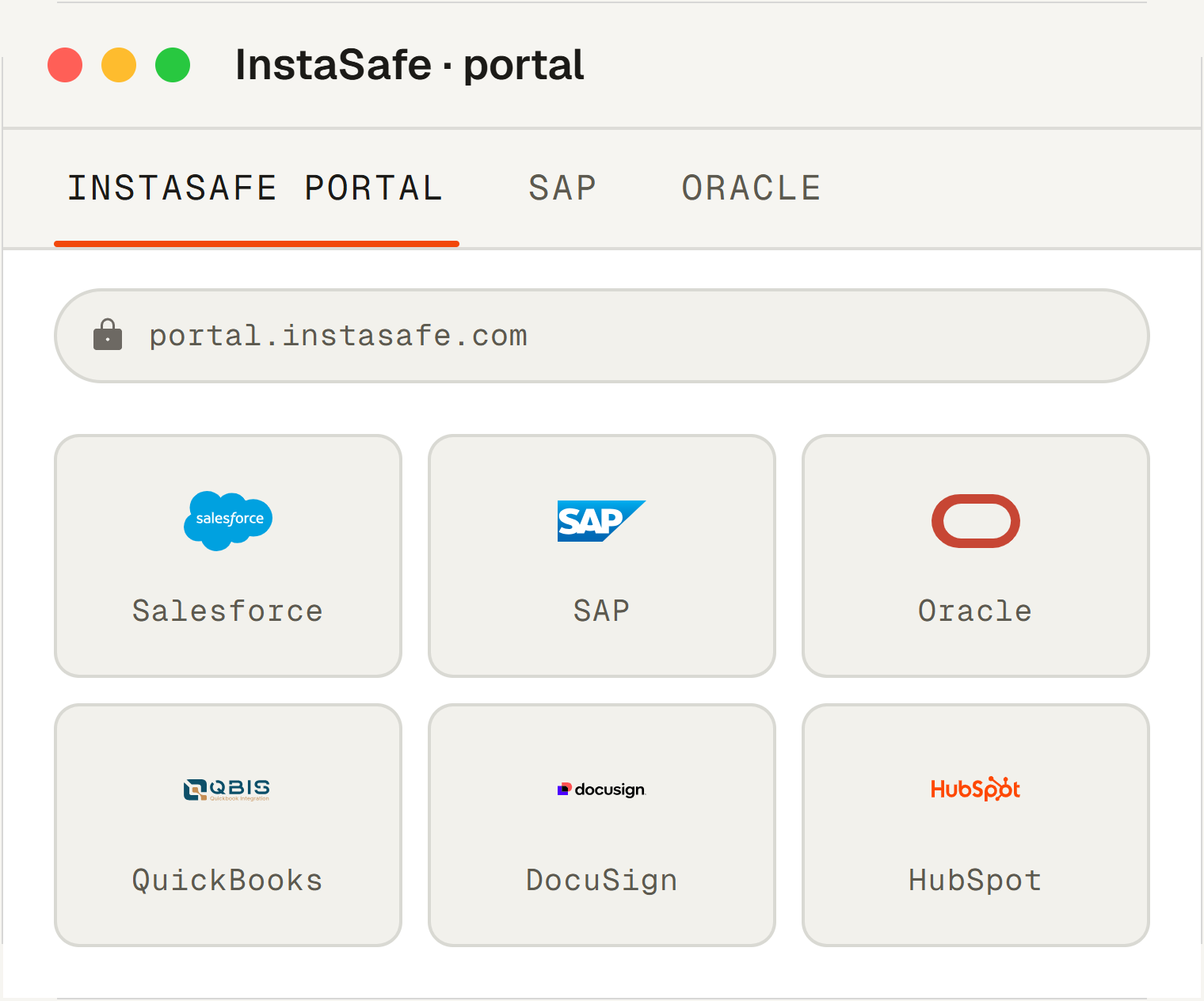
| App types in one portal | 7 | n/a | n/a | Varies |
▸ marks the rows where the difference is architectural rather than a matter of degree — the two you cannot configure your way out of.
Your data never travels through us.
Decisions come from us. Traffic never does. Everything above is a consequence of this one drawing.
Everything an access decision needs, meeting in one place.
Identity, device posture, policy, the apps a person may reach and the record of what they did are not five products here. They are five inputs to the same decision, taken again every time a session opens.






A VPN lets people onto the network.
InstaSafe lets them into one app.
Same people, same devices, same day. The only thing that changes is what a session can reach once it is connected.
With InstaSafe: identity, device and posture are checked, then the gateway resolves exactly one host for this session — payroll.internal. The other six are not denied at the door; they never appear.With InstaSafe: checks pass, then one host resolves — payroll.internal. The other six never appear.
10.0.0.0/8 — no route offered, nothing to discover
The questions that decide it.
Tap a question — or open them all and read straight through.
Talk to us//Ready when you are//
Ditch the VPN. Keep your apps invisible.
Runs alongside the VPN you have, app by app, until there is nothing left to switch off. Nothing to rack, no network to re-architect.
Regulated, air-gapped, or on-premise? See deployment options